
API integration for beginner
Welcome! I'm excited to help you dive into the world of APIs. It's one of the most empowering skills you can learn as a developer because it lets your code talk to the rest of the world.
Before we construct our roadmap and start building, I'd love to know a little bit about your goals. To tailor this session for you, do you have a specific programming language or project in mind for integrating an API, or are you looking to start with general principles?
Let's start with general principles first
Since we are starting with the foundational concepts, let's first map out our learning path. This roadmap will guide us step-by-step from understanding how APIs operate all the way to making programmatic requests.

- The Client: This is the application making the request. It could be a website you are building, a mobile app, or even a simple script running on your computer.
- The Server: This is the powerful computer on the other end that has the data or tools you want to access. It is constantly listening for requests and waiting to serve them.
Can we make a diagram of this relationship?
I would love to! Visualizing this flow makes it much easier to understand how the data actually moves.
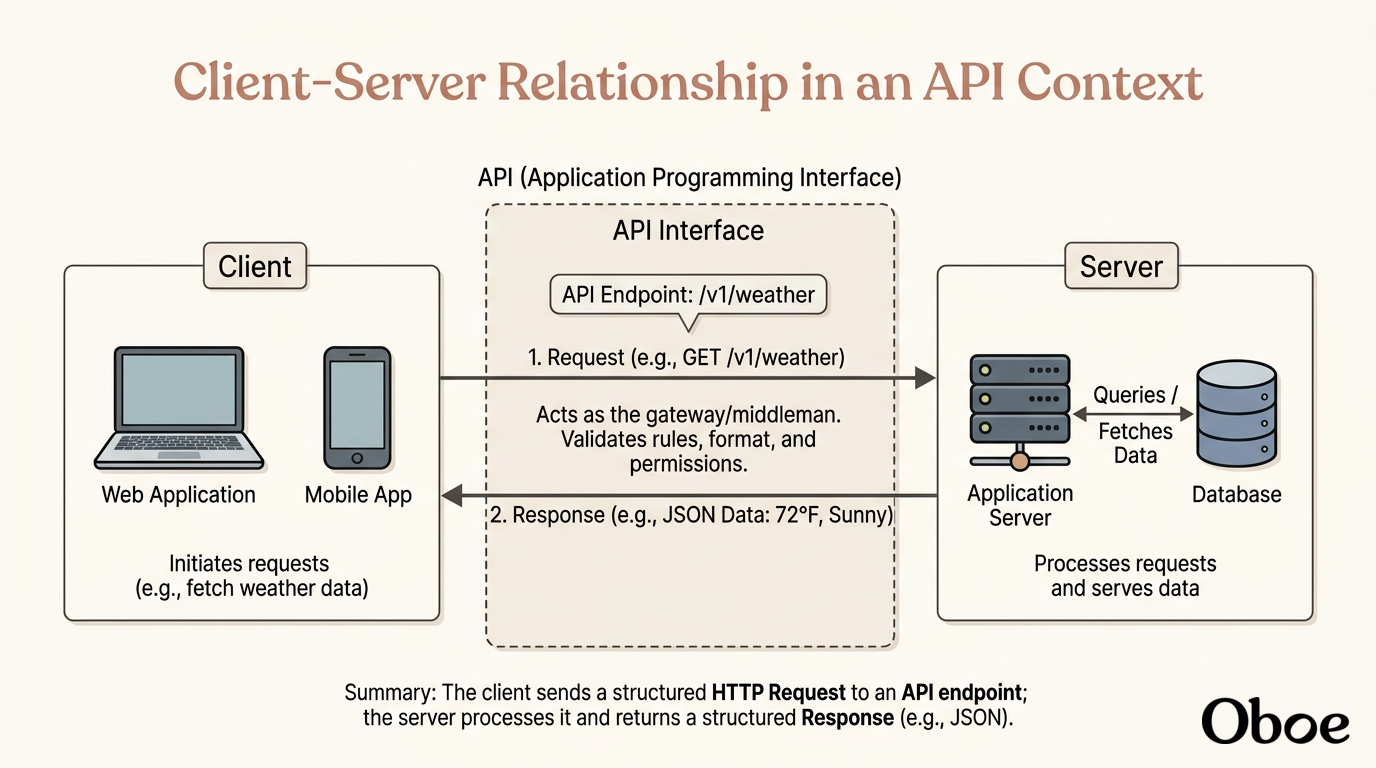
I've kicked off creating a diagram to help you visualize this. It will show how your code acts as the client, sending requests across the web, and how the remote server packages up its data to send back to you.
Now, to make this concrete, let's look at a classic analogy: the restaurant server.
- You (The Client): You sit at a table and look at the menu. You know what you want, but you can't walk directly into the kitchen to cook it yourself.
- The Kitchen (The Server): This is where all the food, ingredients, and chefs reside. They have the capability to prepare your meal, but they are tucked away in the back.
- The Waiter (The ) The waiter takes your order (the request), delivers it to the kitchen, and then brings the prepared food (the response) back to your table. You don't need to know how the kitchen prepared the food; you just rely on the waiter to bring it to you safely.