
Show me a breakdown of the AP US History CED Unit 1
I would love to help you break down AP US History Unit 1! Before we map out our study plan and look at how the different Native American societies developed, I want to make sure I tailor this session perfectly to what you need.
Are you looking for a quick bird's-eye overview of Unit 1, or are you preparing for an upcoming AP test/essay and want to dive deep topic by topic?
I want a quick bird's-eye overview of the unit
A quick bird's-eye overview of Unit 1 is a perfect way to start, as it sets the stage for the entire AP US History course. To get us going, let's take a look at the big picture of how we'll move through this unit together.

The Southwest and Mexico: The Power of Maize
A side-by-side comparison showing a mobile nomadic hunter-gatherer group on the left and a permanent settled cliff dwelling with cultivated maize fields on the right.
I've started generating a visual comparison to help you see this massive transition from a mobile lifestyle to a settled agricultural society.
Continue to nomadic lifestyles in the Great Plains
Let's head north and east from the dry Southwest to look at the vast grasslands of the Great Plains and the Great Basin.
The Plains and Basin: Life on the Move
Unlike the agricultural towns of the Southwest, the Native groups in the and the Great Basin led highly mobile, nomadic lifestyles. The main reason for this was their environment: these regions were incredibly dry and lacked the abundant water and natural resources needed to support permanent farming communities.
Without reliable crops, people in these regions relied on hunting and gathering. In the Great Plains, tribes spent their lives tracking massive migratory herds of bison. In the Great Basin—the dry, bowl-shaped region between the Rocky Mountains and the Sierra Nevada—groups like the Shoshone and Ute searched for seeds, nuts, and small game. Because their food supply was always on the move, they had to be mobile too, meaning they couldn't build permanent towns or accumulate heavy possessions.
Continue to the mixed economies of the Northeast and Atlantic Seaboard
Let's head further east and explore how Native societies adapted to the wetter, forest-rich environments of the Northeast, Mississippi River Valley, and Atlantic Seaboard.
The Eastern Woodlands: Mixed Economies and Abundance
The Three Sisters companion planting method with climbing beans on a central maize stalk above broad squash ground foliage.
I've started generating a visual breakdown of the Three Sisters farming technique to show you how these crops physically supported each other and formed the backbone of these Eastern Woodland societies.
How did they clear forests for farming?
To clear those dense eastern forests, Native societies used a highly clever method called girdling and . Instead of spending weeks trying to chop down massive trees with stone axes, they adapted to their environment with chemistry and fire.
Now, let's wrap up our look at pre-contact societies by traveling to the opposite side of the continent: the Pacific Northwest and present-day California.
The Pacific Northwest and California: Ocean and Abundance
In the Pacific Northwest and California, Native societies didn't need to farm at all. The ocean, rivers, and dense forests provided such an incredible abundance of natural food that they could build large, permanent settlements purely through hunting, foraging, and .
Societies like the Chinook lived in massive, permanent cedar plank houses and developed rigid social hierarchies. Rather than constantly working to grow food, they harvested salmon, hunted marine mammals, and foraged for wild berries and acorns in California. This rich environment allowed them to focus heavily on art, trade, and complex religious ceremonies without ever needing to plant a single seed.
Make me a diagram comparing pre-contact Native regions
You've got it! Visualizing these regions side-by-side is the perfect way to cement how environmental diversity shaped vastly different societies before contact.
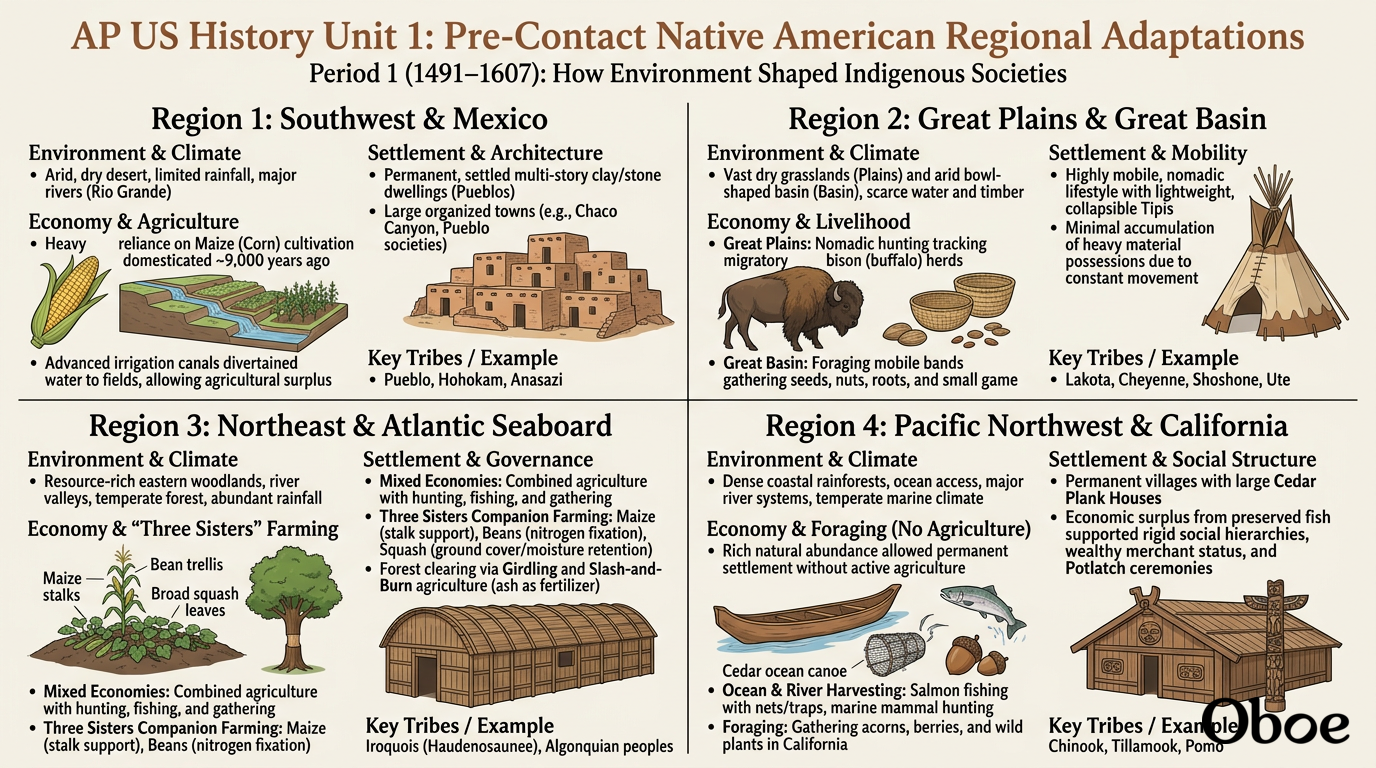
I've set up a diagram that lays out all these pre-contact regions side-by-side so you can easily compare how environment dictated lifestyle, architecture, and food sources.
Now that we have wrapped up our first major milestone—Native American societies before contact—let's check in. How are you feeling about this first step of the unit? If you are ready, we can transition to our next major subtopic: the causes of European exploration, starting with the famous "Three Gs."