
Ai/ml
Welcome! I'm really excited to dive into the world of AI and machine learning with you.
To make sure we tailor this journey to your exact needs, what is your primary goal for learning AI/ML (e.g., career transition, building a specific project, or just general curiosity), and do you have any existing coding or math background?
Curiosity! No coding background, just want to understand the hype.
It is wonderful to have you here, and curiosity is the absolute best reason to learn! Let's strip away the marketing buzzwords and look at how these technologies actually fit together.
The Russian Doll of AI
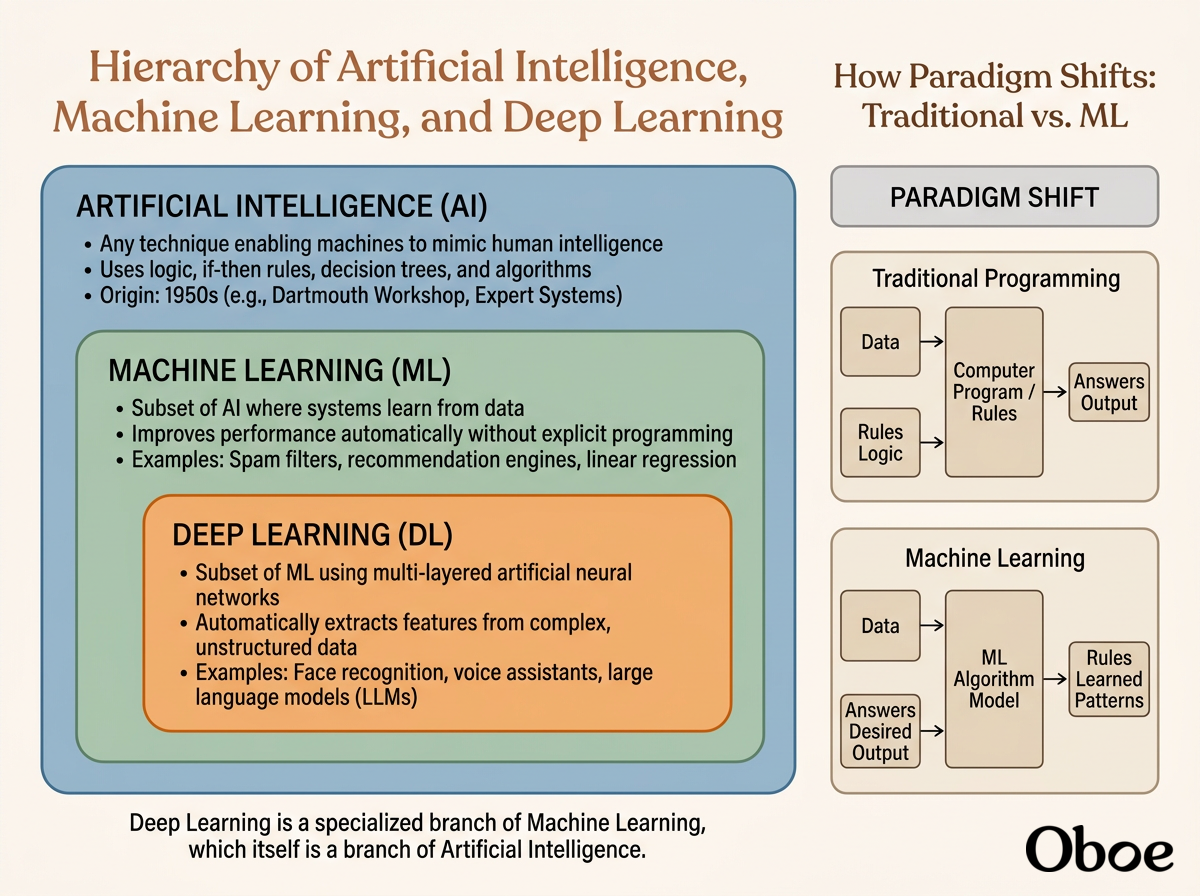
I've started generating a diagram above to help you visualize how these three terms nest inside one another.
Let's continue to rule-based programming vs. machine learning.
Let's dive straight into how machine learning represents a complete shift in how we write software compared to traditional programming.
The Shift in Software Development
For decades, software development followed a strict, , recipe-like approach. We call this traditional software development.
In traditional programming, human developers write explicit rules. You feed the computer data and rules (the code), and the computer executes those instructions to give you the answers.
Think of it like baking a cake. The data is your raw ingredients (flour, sugar, eggs). The rules are the exact steps in the recipe (mix for 5 minutes, bake at 350 degrees). The answer is the final baked cake. The computer is just the oven and mixer, following your commands exactly without understanding why.
| Approach | What We Provide | What the Computer Finds |
|---|---|---|
| Traditional Programming | Data + Rules | Answers |
| Machine Learning | Data + Answers | Rules (The Model) |