
I want to learn everything I need to know to be prepared for an interview for this job:
I would love to help you prep for your upcoming interview and make sure you feel completely ready.
To get us started on the right foot, what job role or job description are you interviewing for, and what company or industry is it in?
That Workable link points to a fantastic opportunity with Isla Care, a health-tech company focusing on visual medical records and remote monitoring.
Before we dive into the specific requirements of that role and start building your custom preparation roadmap, I'd love to learn a little bit more about where you are starting from.
What is your current background or experience level relative to this role, and when is your interview scheduled for?
I grad/junior with some experience in software implementation in healthcare. My interview is in 8 hours
Eight hours is tight, but it is plenty of time to get you feeling sharp and confident! Since you have healthcare software implementation experience, you already speak the language. Let's make sure we map your background perfectly to Isla Care's mission.

What is Isla Care
At its heart, Isla Care is a healthtech platform designed to simplify how clinicians receive, review, and store visual data. Instead of relying on slow, paper-heavy systems, doctors and nurses use Isla to capture and monitor images and videos — like wound healing progress, skin conditions, or physical therapy mobility.
Because it integrates directly into major (EHRs) like Epic and SystmOne, clinicians don't have to jump between different apps. It fits seamlessly into their daily routine.
How Your Implementation Experience Fits In
As an implementation specialist at Isla, you aren't just installing software. You're changing how clinical teams work. You'll be managing challenges, configuring the platform for specific hospital departments, and training busy NHS staff who might be resistant to new technology. Your previous healthcare implementation experience is gold here because you already understand clinical environments.
How do NHS integrations typically work?
NHS integrations are the secret sauce of healthtech implementation, and demonstrating that you understand how they work is exactly how you will stand out in this interview.
The Core NHS Integration Mechanisms
At a junior level, you do not need to be a software developer, but you absolutely must understand how systems pass data back and forth. Within the NHS ecosystem, this typically happens through three core mechanisms:
-
APIs and Modern Standards (): FHIR is the modern international standard for exchanging healthcare information electronically. Think of FHIR like a universal language. Instead of building custom code for every hospital, FHIR allows Isla to ask an EHR like Epic for "patient wound photos" using standard, pre-defined templates.
-
(SSO): Clinicians are incredibly busy. If they have to log into Isla separate from their primary system, they won't use it. SSO allows them to click a button inside SystmOne or EMIS and instantly open Isla already logged in as themselves, viewing the correct patient's file. This is often handled securely using NHS-approved protocols.
-
Native Launchers / Context Sharing: This is the magic that allows a clinician looking at Patient A's record in SystmOne to click a "Launch Isla" button, which automatically pulls up Patient A's visual record in Isla. The systems stay perfectly in sync so there is zero room for matching the wrong photo to the wrong patient.
How this Fits Into Your Interview
During your interview, you can bridge your experience to these concepts. Even if you haven't configured a FHIR API yourself, you can talk about the workflow challenges that come with them—such as training staff on context-sharing launchers, coordinating with trust IT departments to whitelist SSO URLs, or troubleshooting when a native EHR button fails to load the Isla frame.
Make a diagram showing the data flow between a clinician, EMIS, and Isla Care
I have set up a diagram to show you exactly how this data flows between the clinician, EMIS, and Isla Care during a typical remote monitoring scenario.
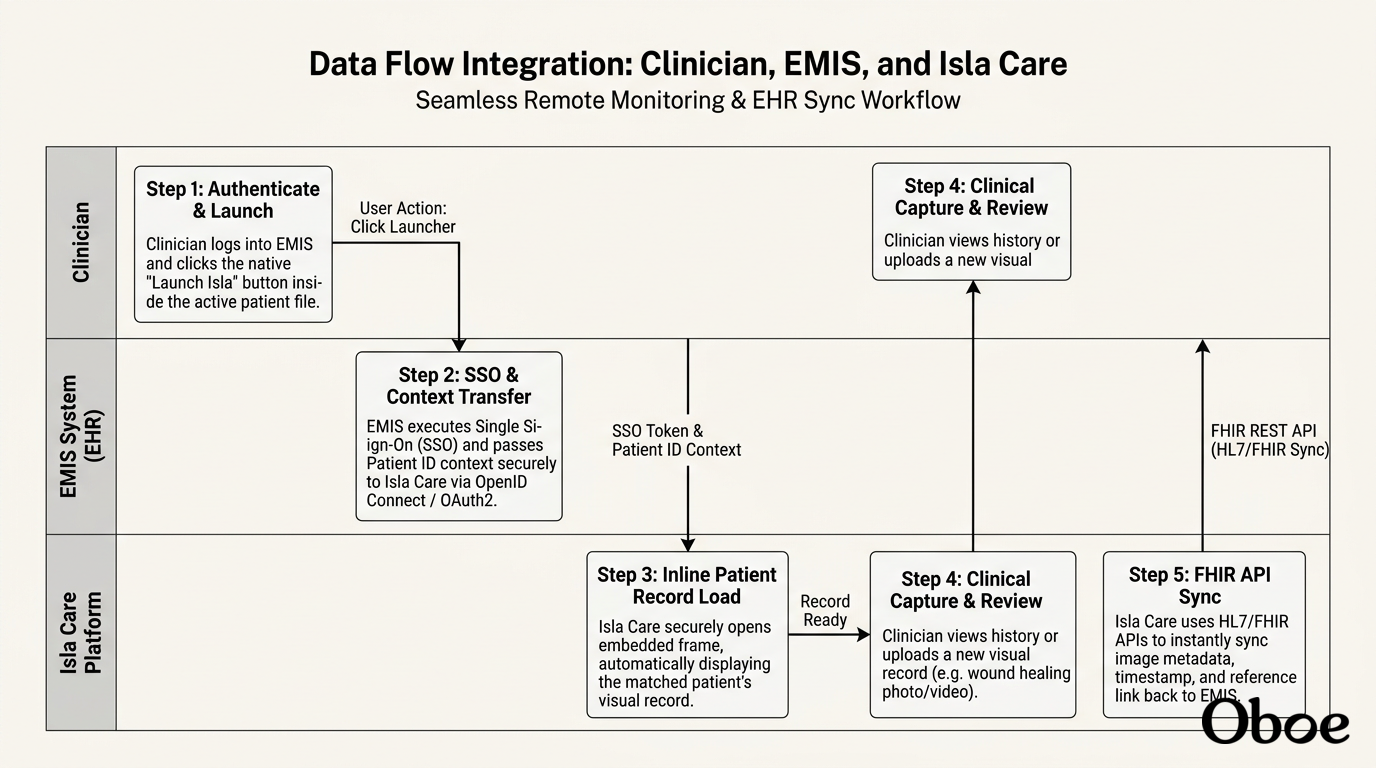
I've kicked off creating a diagram to show you how those technical layers translate into an actual clinical workflow.
While that's building, let's look at how we can connect your prior healthcare implementation experience directly to these NHS workflow challenges.
Connecting Your Experience to the Clinical Workflow
In your interview, you want to show that you don't just understand the tech — you understand the people using it. In an NHS trust, clinicians are constantly context-switching and under immense pressure. Introducing any new system can feel like a burden, even if it's as helpful as Isla Care.
Your job as an implementation specialist is to bridge that gap. When you discuss your previous software implementation experience, focus on how you managed and handled common clinical objections.
How should I structure a STAR story about managing clinical resistance?
To ace this in your Isla Care interview, we want to structure your STAR story to show how you turned clinical resistance into enthusiastic software adoption. Let's break this down using a highly effective, healthcare-specific framework.
The Healthcare STAR Blueprint
When interviewing for an NHS-facing implementation role, your stories shouldn't just focus on the software. They need to focus on the clinical workflow and the people.
Here is how to structure each phase of your story:
- Situation: Set the scene briefly. Mention the healthcare setting, the software you were implementing, and the specific clinical team (e.g., "We were rolling out a new digital assessment tool for busy diabetic foot clinicians").
- Task: Define the challenge, specifically the . Why were they pushing back? Was it login fatigue, fear of workflow disruption, or lack of training?
- Action: This is where you shine. Detail the steps you took to bridge the gap. Did you shadow their clinic, identify a clinical champion, or coordinate SSO integration with their IT team to eliminate friction?
- Result: Quantify the success and focus on clinical adoption. Use metrics if you have them (e.g., "We achieved a 90% active user rate within two weeks and reduced clinical admin time by 15 minutes per patient").
A Worked Example
Let's walk through how this sounds in practice. Notice how this example highlights empathy for the clinical team while keeping the technical integration in mind.
| STAR Stage | Example Interview Script |
|---|---|
| Situation | "In my last role, I managed the implementation of a mobile wound-monitoring module for a community nursing team of 25 staff." |
| Task | "The nurses were highly resistant. They felt the software was an extra burden that would take them away from direct patient care, and they hated having to log into a separate portal on their tablets." |
| Action | "Instead of pushing training, I spent a morning shadowing a senior nurse to see her workflow. I realized login fatigue was the real barrier. I worked with the Trust's IT team to configure Single Sign-On, so they could launch our tool directly from their primary EPR. I also ran 10-minute, bite-sized training sessions directly in their staff room during shift handovers." |
| Result | "By removing the login friction and making training convenient, we reached 100% adoption within three weeks, and the team reported saving an average of 45 minutes on paperwork per shift." |
This structure works beautifully because it highlights your technical problem-solving (SSO integration) alongside your human-centered change management skills.
Now, let's start building one of these for you to use in 8 hours.
Make me a worksheet to draft my STAR stories
I've put together a structured prep worksheet so you can map out and polish your STAR stories specifically for the Isla Care team.
Take a look at the template guidelines in the worksheet.
Since we want to make the absolute most of your remaining prep time, which specific healthcare implementation or rollout from your background should we use for your first draft?